The Fragmentation Tax: What Your Legacy CRM Is Really Costing You
The cost of keeping dozens of disconnected sales, service and marketing tools running around a legacy CRM rarely shows up as a single number. When it is added up, the total is typically larger than expected and scattered across more budgets than anyone had mapped.
Every tool was added for a reason. A CRM to manage customer relationships. A separate forecasting tool because the sales team needed something faster. A helpdesk platform bought before service and sales shared a data model. A marketing automation tool layered on top because the CRM’s own marketing features never quite fit. Each investment solved a genuine problem at the time.
As those tools accumulate around an ageing CRM, they create a fragmented customer engagement estate. Without a connected platform to bring them together, organisations pay a heavy operational price: duplicate licences, fragile custom connections, and manual workarounds to keep customer data moving between sales, service and marketing.
These costs fall across sales operations, customer service, IT and procurement, and the hours employees spend reconciling customer records that should already be consistent.
This is the Fragmentation Tax: the hidden, ongoing cost of running a legacy CRM environment that has evolved over time rather than been intentionally designed.
Finance teams can usually tell you exactly what was spent to license each CRM and each tool bolted onto it. The harder number to calculate is what it costs every year to keep those disconnected systems talking to each other. That annual figure can exceed the original investment, and it compounds year on year, long after the purchasing decision has been forgotten.
Modernising the CRM onto a connected Microsoft Dynamics 365 platform removes much of this cost at the source. When sales, service and marketing already share one system, there is no forecasting tool to duplicate, no service desk to reconcile, and no middleware layer to maintain. The four costs below are largely a description of what a fragmented CRM makes unavoidable, and what a native Microsoft platform makes unnecessary.
Four costs, and one number that stays hidden
The Fragmentation Tax breaks down into four separate costs, each sitting in a different part of the organisation and owned by a different team.
- Licence overlap: When sales, service and marketing tools are bought independently over time, different platforms end up performing the same function. A sales team adopts a forecasting tool that duplicates capabilities already available in the CRM. A regional office implements its own service desk because the central one is too slow. Individually, each decision is minor. Collectively, they mean organisations paying more than once for the same customer data.
- Middleware cost: Every time the CRM and a sales, service or marketing tool are not designed to work together, something must connect them. As the number of point solutions grows, reliance on custom middleware and fragile workarounds grows faster. Each brings licence costs, maintenance overhead, and ongoing operational risk.
- Data reconciliation: Sales, service and marketing teams spend hours checking that customer records, orders, and case histories match across multiple systems. These costs are not logged as technology spend. They are absorbed into working hours, which makes them easy to overlook and hard to add up.
- Delayed transformation: This is often the most expensive of all. Strategic initiatives slow down because the CRM environment cannot support them. A unified customer view takes more time to implement because fragmented legacy systems require extensive custom engineering. An AI copilot for sales and service stalls because customer data exists across multiple systems, each with different definitions and formats. That cost never lands on a technology budget line. It shows up instead as slower delivery, missed opportunities, and postponed customer engagement value.
The table below sets out where these costs arise and why they are so often overlooked.
| Cost | What it looks like | Where it hides |
| Licence overlap | Two or three sales or service tools performing the same function as the CRM, bought independently over time | Procurement records, if anyone aggregates them |
| Middleware cost | A translation layer required for every connection between the CRM and the systems around it | IT infrastructure budgets, usually unaggregated |
| Data reconciliation | Sales, service and marketing staff manually checking that customer records match across systems | Working hours, seldom costed as a business expense |
| Delayed transformation | Customer engagement initiatives scaled back or abandoned because the CRM could not support them | Nowhere. This is the cost with no natural home in any report. |
The four components of the Fragmentation Tax.
What research confirms
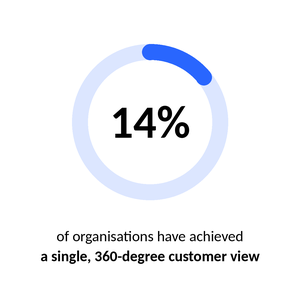 Gartner, organisations that have achieved a 360-degree view of the customer |
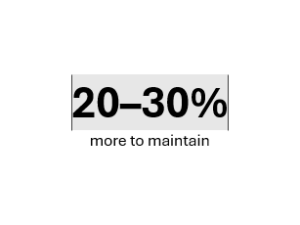
|
Research into CRM shows both sides of the Fragmentation Tax. Gartner finds that only 14% of organisations have achieved a 360-degree view of their customer, while 82% still aspire to it. More recent Gartner research reports that legacy CRM costs 20% to 30% more to maintain and can delay AI adoption. Those findings map directly to the costs outlined above: fragmented customer data creates reconciliation work across sales, service and marketing, while an ageing CRM environment adds maintenance cost and slows the initiatives that depend on connected customer data.
None of this gives your organisation its own Fragmentation Tax figure. Every CRM environment has its own mix of licences, integrations, point solutions and manual workarounds. What the research establishes is that keeping a fragmented CRM running carries a measurable cost, and that cost extends beyond the CRM licence itself.
“The research tells you the problem is real. Your own CRM tells you what it is costing you.”
The Fragmentation Tax is a choice. It does not have to be yours
Fragmentation is never a deliberate strategy. No organisation sets out to build a CRM that costs millions a year simply to hold together. It accumulates, one reasonable decision at a time. By the time the pattern is visible, it looks less like a mistake and more like the way things have always worked.
Addressing it takes a deliberate decision, and that is only possible once the cost of inaction has been quantified. The goal is not to dismantle what works, but to put a number on what the current approach is costing every year it continues.
Organisations that make progress here do not start with a large transformation programme. They start by asking finance, sales and service leaders to produce the number together, using the four components above as a framework. That number changes the entire conversation.
A cost that was previously invisible, buried across several budgets with no single owner, becomes a specific figure the board can decide whether to keep accepting.
Where Hitachi Solutions fits in
Hitachi Solutions works with organisations to quantify the true cost of the current legacy CRM environment, build the board-level case for change, then replace the fragmented CRM in a sequence that reduces cost without disrupting sales and service teams already at work.
As a dedicated Microsoft-first integrator focused on customer engagement, Hitachi Solutions has worked across the full range of sectors where fragmentation accumulates most acutely.
The work starts with a structured discovery process: mapping the current CRM environment and quantifying what it is actually costing. That means tracing licence overlap across procurement records, surfacing middleware spend from IT infrastructure budgets, calculating the staff time consumed by manual customer data reconciliation, and estimating the value of customer engagement initiatives slowed or stalled by CRM complexity. For many organisations, it is the first time anyone has put those four numbers in the same document.
Hitachi Solutions replaces the fragmented CRM at the centre of this cost with Microsoft Dynamics 365 Sales and Customer Service, giving sales, service and marketing one connected platform instead of a patchwork of point solutions. Microsoft Dataverse, Microsoft Fabric and the Power Platform underpin it as the unified data foundation, so the consolidation holds without recreating the same fragmentation in a different shape. The outcome is a lower Fragmentation Tax and a modernised customer engagement platform built to support the growth agenda.
Talk to our team at Hitachi Solutions and start with yours today.
Built to work as one.
Sources
- Gartner Newsroom, 19 January 2022, “Gartner Marketing Survey Finds Only 14% of Organizations Have Achieved a 360-Degree View of their Customer”
- Gartner, 13 March 2026, “Strategic CRM Modernization for IT Leaders: Reducing Costs and Enhancing AI Capabilities”
- Hitachi Solutions, Business Applications (Dynamics 365 Sales, Customer Service and Power Platform)
- Hitachi Solutions, Data Transformation (Dataverse and Microsoft Fabric)