How Dynamics 365 Is Enhancing Quality Management



Quality management plays a critical role in ensuring consistent product quality, reducing operational risk, and supporting compliance across manufacturing, distribution and supply chain operations.
With Dynamics 365 Finance & Supply Chain Management version 10.0.44, Microsoft introduced several enhancements to Advanced Quality Management that provide greater automation, flexibility and control throughout the quality process. These updates help organisations move quality management from a reactive activity to a more integrated part of day-to-day operations.
In this article, we explore some of the key enhancements, including new quality associations, CAPA management, acceptance sampling, flexible sampling plans and sample management.
New Quality Associations
One of the most practical additions is the ability to create Quality Orders for both Transfer Orders and Customer Returns. Previously, many organisations relied on manual processes or offline inspections for these scenarios.
Transfer Orders
Many organisations use transfer orders to replenish regional warehouses, support retail store replenishment, or move raw materials and semi-finished goods between plants. Historically, quality inspections for these movements often required manual intervention.
Quality Orders can now be triggered automatically during key transfer order events, including:
- Receive Transfer Order
- Picking Process Scheduled
- Registration
- Ship Transfer Order
This functionality is available for both Advanced Warehouse Management and standard warehouse operations.
For organisations using third-party logistics providers, particularly overseas warehouses, the ability to trigger inspections when inventory is received provides an additional layer of control before stock becomes available for use or sale.
Customer Returns
Customer Returns are another welcome addition to the Quality Association framework.
Previously, returned products often required manual Quality Orders or separate inspection processes. Organisations can now automate inspections of returned goods during registration, or before and after packing slip posting.
This is particularly useful when assessing whether returned products can be returned to stock, require further investigation, or should influence customer credit decisions. Because quality inspections take place before credit is applied, businesses can make more informed decisions based on the actual condition of returned items.
CAPA (Corrective and Preventive Actions)
Many organisations already use Non-Conformance Reports (NCRs) and case management processes to manage quality-related issues. CAPA extends these capabilities by providing a more structured framework for investigating, managing and resolving quality concerns.
CAPA allows organisations to classify issues, identify root causes, assign ownership, and track resolution activities through defined stages until completion. It supports both internal quality issues and external concerns, such as customer complaints.
By introducing a more formal corrective and preventive action process, organisations can move beyond simply recording problems and begin addressing the underlying causes of recurring quality issues.
Acceptance Sampling
Acceptance Sampling introduces a more sophisticated approach to managing quality inspections.
Traditionally, organisations often selected sample sizes manually and used fixed pass/fail criteria. Dynamics 365 now allows businesses to calculate representative sample sizes and define acceptable defect thresholds based on industry-standard Acceptance Quality Level (AQL) principles. Defects can be classified as minor, major or critical.
This enables inspection criteria to better align with operational and regulatory requirements. Critical defects can be assigned lower tolerance levels, helping to ensure quality standards are maintained without introducing unnecessary inspection effort.
Another useful enhancement is Quick Results Entry, which enables users to enter multiple test results without repeatedly returning to the main quality order screen. For organisations managing large quality orders, this can significantly improve efficiency and reduce administrative effort.
Flexible Sampling Plans
Historically, quality associations were restricted to a single sampling plan, resulting in fixed sampling quantities unless manually adjusted.
Flexible Sampling Plans remove this limitation by allowing multiple sampling groups to be combined into a single plan, with rules that determine when inspection levels should increase or decrease.
This provides a more intelligent approach to quality control. Suppliers or processes that consistently meet quality expectations can move to lower inspection levels, while recurring failures can automatically trigger increased inspection requirements.
The result is a more efficient quality management process that helps organisations focus resources where risk is highest, while reducing unnecessary inspections where quality performance is consistently strong.
Sample Management
Sample Management is particularly relevant for industries where quality assurance and regulatory compliance are essential, including pharmaceuticals, food and beverage, chemicals, and life sciences.
The functionality supports two approaches:
Inline Process Sampling
Samples are collected manually during production before products are reported as finished. When a sample is created, a corresponding Quality Order is automatically generated.
Continuous Process Sampling
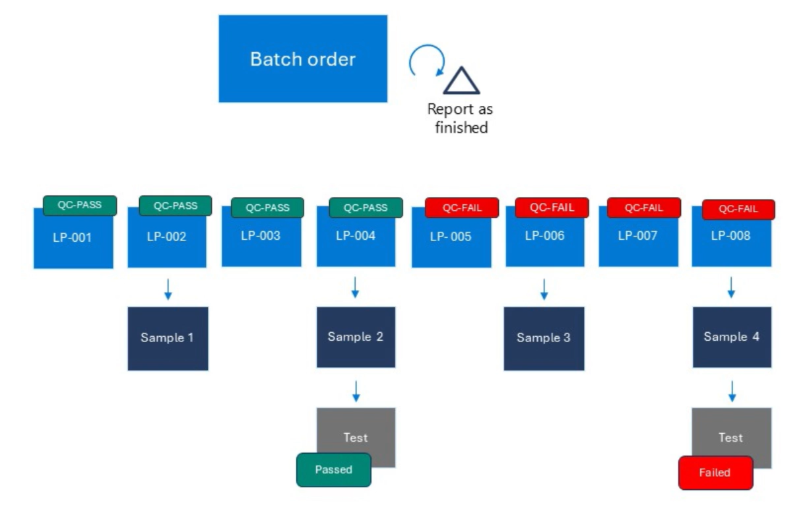
Samples are automatically generated at predefined intervals throughout production. Organisations can determine how frequently samples are taken, how many samples require testing, and how inventory status is updated based on the inspection results.
The example below shows a continuous sampling process in which samples are taken at defined intervals during production. As test results are recorded, inventory statuses are automatically updated to reflect whether products have passed or failed quality inspection. This helps ensure that inventory is released only when predefined quality requirements have been met.
Why These Enhancements Matter
Whilst each enhancement delivers value individually, together they represent a significant step forward for organisations seeking greater control over quality processes within Dynamics 365.
By expanding automation, reducing manual intervention and introducing more intelligent inspection methodologies, these capabilities help organisations:
- Improve operational consistency
- Reduce quality-related risks
- Strengthen compliance processes
- Improve supplier quality management
- Make faster, more informed decisions
- Increase efficiency across quality operations
For organisations operating in highly regulated industries or complex supply chain environments, these enhancements provide a stronger foundation for managing quality directly within Dynamics 365 Finance & Supply Chain Management.
Looking Ahead
Quality management is no longer just about identifying defects. It is about creating consistent, repeatable processes that improve operational performance across the entire supply chain.
The latest enhancements to Advanced Quality Management help organisations achieve this by embedding quality controls more deeply into warehouse, manufacturing and returns processes, whilst providing greater flexibility in how inspections are planned, executed and managed.
If you’d like to understand how these new capabilities could support your quality management processes, our Dynamics 365 specialists can help you assess your current approach and identify opportunities to take advantage of the latest functionality within Dynamics 365 Finance & Supply Chain Management.