FABCON 2026 Recap: Where Microsoft Fabric Moved From Vision to Velocity
 4 minute read


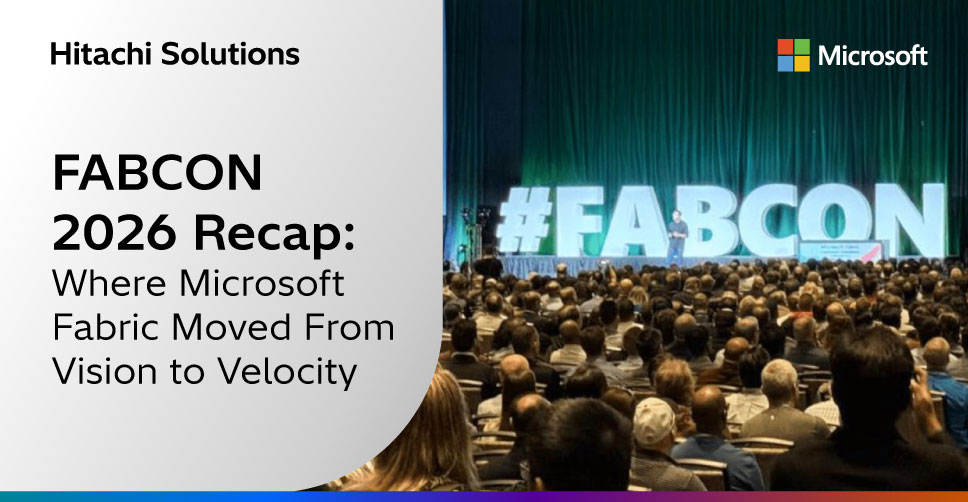
FABCON 2026 delivered exactly what many data leaders are asking for right now: less hype, more clarity, and a whole lot of practical conversations about how Microsoft Fabric is being used in the real world.
From packed workshops to nonstop conversations on the expo floor, the energy in Atlanta was unmistakable. This wasn’t just about what could be possible with Fabric and AI—it was about how organizations are actively modernizing data platforms, building stronger foundations, and turning strategy into execution.
For the Hitachi Solutions team, FABCON reinforced something we see every day in our work with customers: progress happens fastest when architecture, governance, and business outcomes are discussed together—face to face.
Why in‑person conversations still matter
One of the most valuable parts of FABCON wasn’t a slide or a demo—it was the chance to sit down with customers and talk openly about what’s next.
We had a great conversation with Philip Rainsberger and Tyler Beauchea from CHANEL, focused on how Microsoft Fabric can support global operations, and how a strong, unified data foundation today enables broader AI ambitions tomorrow. Discussions like this go beyond tooling. They’re about priorities, constraints, and sequencing: what to modernize first, how to scale responsibly, and how to make sure AI initiatives are grounded in trusted data.
Those customer conversations are exactly why events like FABCON matter. They give teams space to align on goals, pressure‑test ideas, and move from high‑level strategy to real‑world impact.
What Microsoft Announced: The Big Fabric Takeaways
Fabric IQ brings business context — and planning — directly to the data
Microsoft introduced Fabric IQ as a semantic foundation for the platform, using an ontology to organize data into business entities and relationships so analytics and AI operate with consistent meaning. Microsoft also unveiled Planning in Fabric IQ, extending the platform beyond analytics to support budgeting, forecasting, targets, and scenario modeling — all built on governed Fabric data and shared semantics, as outlined in Microsoft Fabric and FabCon announcements.
OneLake continues driving convergence across the data estate
Microsoft continues to position OneLake as the unifying data layer for Fabric. At FabCon, Microsoft introduced Database Hub in Fabric (early access) as a centralized experience for managing databases such as Azure SQL, Cosmos DB, PostgreSQL, SQL Server (via Azure Arc), MySQL, and Fabric-native databases. Microsoft also highlighted continued expansion of OneLake mirroring, with Oracle and SAP Datasphere now generally available, alongside capabilities like shortcut transformations that convert structured files (including JSON and Parquet) into Delta tables — reducing the need for traditional ETL pipelines.
Governance and security expand further inside Fabric
Microsoft reinforced its focus on governed AI and analytics by extending Microsoft Purview DLP coverage in Fabric to additional structured data endpoints, including SQL, KQL databases, and mirrored databases. Microsoft also described OneLake security (public preview) as a fine‑grained access control model applied at the data layer, designed to help enforce consistent security policies across multiple Fabric engines.
What this means for organizations adopting Fabric
Taken together, FABCON 2026 made one thing clear: Microsoft Fabric is moving firmly into its execution phase.
Organizations are no longer asking if they should modernize their data platforms—they’re asking how to do it well, how to do it safely, and how to ensure it delivers business value quickly. The conversations we had throughout the week reflected that shift.
At Hitachi Solutions, this aligns directly with how we work with customers: helping them design data platforms that don’t just launch, but operate, supporting analytics today while laying the groundwork for AI tomorrow.
If you didn’t get a chance to connect with us at the event, or if you want to continue a conversation that started there, we’d love to keep talking about how Microsoft Fabric can support your data and AI goals. Click here to reach out.